When Stress Shows Up Everywhere
Let’s say things are feeling a little off. Or maybe more than a little. You’ve got a tight spot in your neck or between your shoulder blades. Was that from phone use or your computer desk? You should probably check into that sometime, after you get through that upcoming deadline at work. You haven’t been sleeping super well, and apparently the shoulders are keeping a running tab.
Your stomach isn’t feeling great either, even though you’ve been trying to eat reasonably healthily. Are you going to have to cut out gluten? You certainly hope not!
It’s probably “just stress”. You plod on for a few weeks, and the deadline passes. Nobody gets fired or yelled at. You give yourself permission to relax a little.
You finally get a decent night’s sleep. For a few days, you think you may have turned a corner. Then you wind up having a difficult personal conversation, you’re up half the night thinking about it, and before you know it your shoulders are tightening again, your stomach starts making its opinions known, and by Thursday you’re running on fumes.
Maybe none of it seems catastrophic. You’re just never fully well. You’re “wired and tired”, overwhelmed, probably feeling a little confused, irritated, or anxious. You know something’s off, but you can’t quite see how it all fits together.
Maybe you talk to your doctor. Sometimes you have a diagnosis. Sometimes you have several. Sometimes the tests haven’t turned up anything conclusive, and you’re left with the unsettling sense that your body has become a slightly disorganized committee. Everyone is sending urgent emails; nobody seems to be reading the whole thread.
That is often where my work begins: listening for patterns in the chaos.
When symptoms travel together
Poor sleep and insomnia can make pain harder to bear. Pain can make sleep harder to find. A difficult week may leave you more tense, less hungry, more irritable, or suddenly aware of a familiar headache. By the time one part settles, another may have taken its place. Sometimes symptoms tend to ebb and flow with the seasons or hormonal cycles.
When symptoms show up like this, treatment may help for a while, but the symptoms pop up again, or change, while somehow staying the same.
This is exactly where the work I do with patients can become such a useful approach. I look at the person as a whole and asks how sleep, pain, digestion, and emotion may be affecting or reinforcing each other.
It’s not “all in your head”
Stress isn’t just something that happens in your mind. It has physical, psychological, and emotional effects. Those effects can reinforce each other, creating loops that are difficult to break out of.
That’s not to say that stress is the cause of everything, or that it should be used to dismiss symptoms.
People can be stressed and have an injury. They can have anxiety and an underlying medical condition. They can have digestive disease, hormonal changes, autoimmune illness, fibromyalgia, ME/CFS, or another diagnosis that deserves appropriate care.
At the same time, having a diagnosis does not mean that sleep, stress, pain, digestion, mood, and recovery are unrelated. And of course, living with an illness can itself be stressful, that stress adding another layer to an already existing condition.
Rather than trying to draw increasingly blurry distinctions between “physical” and “psychological” symptoms, my approach is to look at “What’s the overall pattern here, and what can we realistically influence for the better?”
Why it can be hard to come down
Some people call this feeling “stuck in fight or flight” or “always on high alert.” The words may not describe every part of what’s happening, but they capture something familiar: your body still seems to be preparing for trouble, even after the immediate problem has passed.
Your nervous system helps you meet demands. That’s a good thing. It gets harder when one demand hands the baton to the next before you’ve had much chance to recover. The meeting ends; you’re already thinking about tomorrow’s. You get into bed; your mind starts replaying a conversation from six hours ago. Nothing urgent is happening in that moment, but your body hasn’t received the news.
Over time, you may find yourself easier to wind up and harder to settle. “Nervous-system dysregulation” is one way to describe that pattern. It doesn’t tell us why it’s happening in your particular case, but it points us toward a useful question: what keeps activating the system, and what actually helps it recover?
I explore the why more fully in Tigers, To-Do Lists, and Traffic Troubles. Here, I want to focus on what working with that pattern might look like.
I’ve Been There
I came to acupuncture and Chinese medicine because I was burned out, exhausted, and dealing with several symptoms at once. I was looking for help with my own health, but also for a way to understand how to live well in the modern world, with body and mind in the same conversation.
It gave me a pathway into those questions. My twenty plus years of practice and teaching have deepened them: how do these ancient ideas about health and well-being help people living the lives we actually have now? Finding useful answers to that question has become my life’s work.
So when someone feels that everything is going haywire but nobody has really figured out why, I take that seriously. It’s why I do what I do.

What working together looks like
When multiple things are going on at once, Chinese medicine gives me a lens to see the big picture, not just an isolated part. You might come in to get some help with your headaches, and wonder why I might ask you about your sleep or your digestion. That’s a feature, not a bug! Sometimes people are pleasantly surprised to notice those other symptoms shifting too.
At your first appointment, we make room for the whole picture: what brought you in, how things developed, what has already been tried, and what you most want to change. We look at the connections without assuming in advance that every symptom has the same cause. Then we begin with a treatment plan that makes sense for you as a whole and adjust it according to your response.
Nervous system regulation is an important part of my approach when chronic stress, tension, or feeling constantly on alert or “stuck in fight or flight” seems to be affecting symptoms or making it harder to recover.
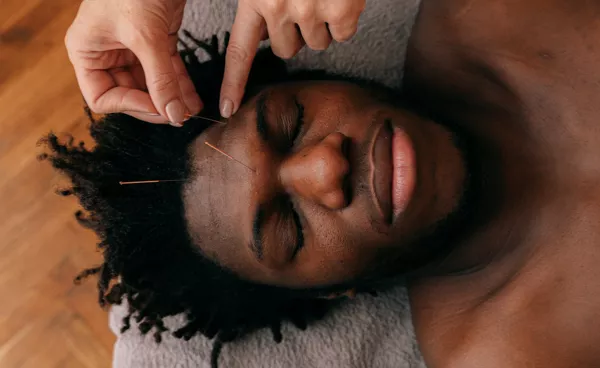
My approach to acupuncture is generally gentle, and I don’t always put needles where it hurts. The points I choose reflect the pattern I see across your symptoms, including the relationships Chinese medicine describes through its channels. Treatment is tailored to what I find and to how you respond. You should understand what I’m doing and have room to tell me what feels useful, uncomfortable, or unclear.
People often notice an increased sense of ease, relaxation, and settling during the acupuncture treatments, and I often get comments like “wow, I feel like myself again!” or “I didn’t realize how much tension I was carrying until I dropped it”. That matters, but it’s just a start.
I’m also interested in what happens after you leave the room. Can you recover a little more readily? Does the headache return less often? Does the relief from pain begin to hold? We follow the changes that matter in your life, rather than assuming that feeling relaxed on the table is the whole job.
The part you can take home
Treatment is one part of the work. I also offer perspective and practical guidance so that you can develop your own capacity to settle and recover between visits. That might mean noticing an early sign that you’re bracing, finding a more workable rhythm of activity and rest, noticing where you’re holding your breath, or learning which small changes genuinely help your sleep or energy. We choose things that fit your life, then see what happens.
This isn’t a test of whether you can become a perfect patient. If you’re already exhausted, you probably don’t need another ambitious self-improvement project. You need somewhere sensible to start.
The first shift may be modest: a little more ease in your body, a better night sleep, a flare that doesn’t take quite as long to recover from, or simply a clearer sense of what sets things off. From there, we can adjust. Progress isn’t always tidy, but it should become something we can observe and discuss together.

Is acupuncture a fit for you?
If the descriptions in this article sound familiar, this work may be a fit whether you have a diagnosis, several diagnoses, or just a handful of confusing symptoms. You may recognize yourself if:
- you feel overwhelmed, “wired and tired,” “stuck in fight or flight” or unable to switch off and recover
- pain or headaches, sleep, digestion, mood, and energy seem to affect one another, or flare when life gets demanding
- symptoms keep returning or changing shape, or relief from treatment doesn’t seem to hold
- your symptoms follow a noticeable menstrual or perimenopausal pattern
- you feel that something is being missed when each concern is treated separately
You don’t need to have all these things happening at once for this approach to be worth exploring.
This may be an especially good fit if you’d like to understand what might be keeping the pattern going, and are open to trying small, manageable changes between appointments. You also don’t need to arrive knowing whether stress is part of the picture—or even exactly what to call the problem.
Next steps
If this speaks to you, you can book an initial acupuncture appointment or a complimentary phone consultation with me at Acacia Health in Victoria.
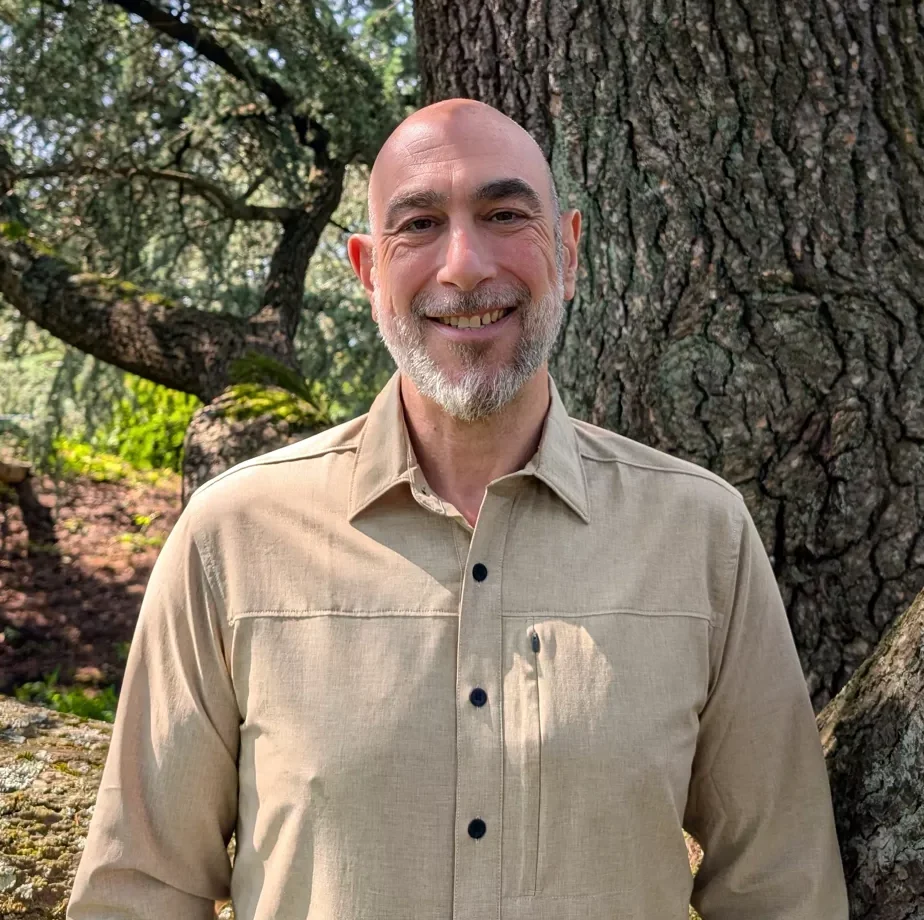
Reuven Freesman is a Doctor of Traditional Chinese Medicine and Registered Acupuncturist at Acacia Health in Victoria, with over 20 years of clinical and teaching experience and a focus on nervous system regulation, stress, and complex pain. You can read more about his approach on his bio page.
- Pain and headache — Acupuncture for chronic pain: individual patient data meta-analysis (2018)
- Insomnia — Acupuncture for chronic insomnia: systematic review and meta-analysis (2025)
- Functional dyspepsia — Systematic review of randomized trials (2026)
- Nervous-system effects — Acupuncture and heart-rate variability (2023)
- How sleep and pain affect each other — Sleep deficiency and chronic pain (2020)