How an Ancient Nervous System Navigates the Modern World
Part 3 of 3 in the series When Stress Doesn’t Switch Off
This series looks at chronic stress through four clinical lenses: how to identify it, why the nervous system struggles to let it go, what it does to the body over time, and what actually helps.
Part 1 – Is Your Body Stuck in Stress Mode?
Part 2 – Why Your Nervous System Stays on High Alert
Part 3 – Tigers, To-Do Lists, and Traffic Troubles (you’re here)
Let’s be honest: modern life is a bit of a gong show.
Our phones buzz before we’re out of bed. Our calendars are full before the week even starts. Emails breed overnight. There are bills to pay, kids to wrangle, parents to worry about, reports to finish, and approximately seventeen things you forgot to put on your to-do list in the first place.
No wonder so many of us feel like we’re constantly running on fumes.
The surprising part isn’t that we’re stressed.
The surprising part is that our nervous systems are doing exactly what they were designed to do.
Your nervous system isn’t outdated. It’s brilliant.
The human nervous system has been refined over hundreds of thousands of years. It evolved in a world where the major challenges to survival were immediate and obvious.
- Find food.
- Avoid becoming food.
- Try not to fall off a cliff.
- Repeat.
Those were serious problems. But they also had one important feature: they ended.
You escaped the predator. You found dinner. You got home.
Your body could return to baseline.
The problem isn’t that modern life is dangerous. It’s that it’s relentless.
Modern life is different.
Not necessarily more dangerous, but infinitely more demanding. We’re constantly responding to demands for our attention while simultaneously predicting what might happen next. Often, our bodies begin reacting to those imagined outcomes before they ever arise.
One of the remarkable features of the human brain is its ability to imagine the future. Before we’ve even sent the report, we can imagine our boss hating it. Before our teenager gets home, we’ve already rehearsed three different disasters. Before opening the banking app, we’ve mentally spent next month’s paycheque twice.
This ability to predict is one of humanity’s greatest strengths.
It’s also one of the reasons so many of us spend our days physiologically preparing for things that haven’t happened.
Your nervous system doesn’t respond only to what is happening. It also responds to what it believes might happen.
The body doesn’t need an actual tiger to begin preparing for survival.
Sometimes it only needs a convincing story about one.
Your Nervous System Thinks Your Inbox Is Trying to Kill You
Imagine lying safely in bed at two in the morning.
The doors are locked. You’re warm. You’re fed. Nothing is chasing you.
Meanwhile your heart is racing because tomorrow you have a difficult conversation at work.
From your conscious mind’s perspective, those two situations are obviously different.
Your nervous system often responds as though both deserve preparation.
Evolution forgot to include a setting called “Ignore that email until after lunch.”
So how do we calm the system down?
Many people try to think their way out of stress.
Sometimes that helps.
But the nervous system doesn’t learn primarily from reassurance.
It learns from evidence.
Evidence can come in many forms: a walk through the forest, genuine laughter with a friend, moving your body, sleeping well, sharing a meal, taking a slow breath instead of another shallow one at your keyboard.
These experiences don’t convince your nervous system that life is perfect. They remind it that, in this moment, you’re not being chased by a predator, running out of food, or fighting for your survival.
That’s a very different message.
A Different Way to Think About Meditation
Meditation is often described as learning to pay attention to the present moment.
That’s true.
But from a nervous system perspective, it may also be understood as repeatedly interrupting prediction with reality.
Each time you notice your mind rehearsing tomorrow’s problems and gently return your attention to your breath, the sounds around you, or the feeling of your feet on the floor, you’re asking your nervous system to update its understanding using what’s actually happening instead of what it merely predicts might happen.
You’re giving it better information.
The good news? You don’t need to meditate on a mountaintop for three hours. Every time you gently bring your attention back to the present moment, you’re giving your nervous system another chance to update its map.
Working with Your Nervous System
The goal isn’t to eliminate stress. Life will always contain uncertainty, responsibility, and challenge.
The goal is to help your nervous system become better at distinguishing between an immediate emergency and an imagined future.
When that happens, something interesting begins to shift.
We become less reactive.
More resilient.
More capable of responding thoughtfully instead of reflexively.
Practices like movement, meditation, time in nature, meaningful connection, and acupuncture all work in different ways, but they share a common purpose: they help restore communication between the body and the reality of the present moment.
If the nervous system learns from evidence rather than reassurance, then the obvious question becomes: what kinds of experiences provide that evidence?
Movement is one.
Nature is another.
Meditation can help.
And, perhaps surprisingly for many people, so can acupuncture.
Let’s Talk Acupuncture: What People Say
Since I’m an acupuncturist, I’m admittedly a little biased. But I’m also encouraged by the growing body of research showing that acupuncture can be a powerful tool for supporting the nervous system during times of stress. Just as importantly, I’ve had the privilege of watching thousands of treatments unfold over more than twenty years in practice.
People describe the experience in remarkably similar ways.
- “I feel like myself again.”
- “I didn’t realize how much I was carrying until after the treatment, when it all dissolved.”
- “I felt a wave of warmth and tingling, followed by this deep relaxation through my whole body.”
- “I suddenly remembered who I used to be before all this ‘life stuff’ piled up.”
- “I slept through the night for the first time in months.”
Those comments have always fascinated me.
Because they aren’t simply descriptions of relaxation.
They’re descriptions of a nervous system that has begun responding differently.
The Experience of Acupuncture
During an acupuncture treatment, something happens that’s all too rare in modern life: for a little while, there is nowhere else to be.
You aren’t answering emails.
You aren’t making decisions.
You aren’t planning tomorrow.
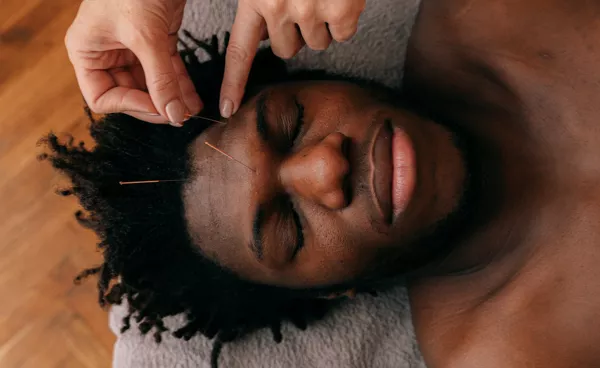
You’re lying comfortably in a quiet room while gentle stimulation from the acupuncture needles combines with stillness, warmth, safety, and the simple experience of being cared for.
From the perspective of your nervous system, that’s a very different environment than the one it’s usually navigating.
Earlier we talked about the nervous system learning from evidence rather than reassurance.
An acupuncture treatment provides a whole collection of evidence, all at once.
Your breathing naturally slows.
Your muscles begin to soften.
Your attention shifts away from future problems and back toward the present moment.
Your body discovers, through direct experience rather than positive thinking, that it doesn’t have to remain in survival mode every second of the day.
That’s why people often tell me they don’t simply feel “relaxed.”
They feel like themselves again.
What the Science Says About Acupuncture and Stress
Scientists are still working out exactly how acupuncture produces these effects, but several mechanisms appear to be involved.
Research suggests acupuncture helps regulate the autonomic nervous system by increasing parasympathetic (“rest and digest”) activity while reducing physiological patterns associated with chronic stress. Studies have also demonstrated improvements in heart rate variability (HRV), one of the best non-invasive measures we have of nervous system regulation. Other research suggests acupuncture influences brain regions involved in processing stress and emotion, while also affecting neurotransmitters and hormonal pathways associated with pain, mood, and resilience.
No single study explains everything we observe in the clinic, and there is still much to learn. That’s true of most complex biological systems.
But taken together, the evidence increasingly supports what many patients already know from firsthand experience: acupuncture appears to help the nervous system shift from chronic protection toward greater regulation, recovery, and resilience.
Your nervous system has been trying to keep you alive since long before you were aware of it.
It isn’t broken.
It isn’t overreacting.
It’s doing its best with the information it has.
Sometimes the kindest thing we can do is give it better evidence.
Reuven Freesman is a Doctor of Traditional Chinese Medicine and Registered Acupuncturist at Acacia Health in Victoria, with over 20 years of clinical and teaching experience and a focus on nervous system regulation, stress, and complex pain. You can read more about his approach on his bio page.
- Hamvas S, Hegyi P, Kiss S, Lohner S, McQueen D, Havasi M. Acupuncture increases parasympathetic tone, modulating HRV — a systematic review and meta-analysis. Complementary Therapies in Medicine. 2023;72:102905. https://doi.org/10.1016/j.ctim.2022.102905
- Chung JWY, Yan VCM, Zhang H. Effect of acupuncture on heart rate variability: a systematic review. Evidence-Based Complementary and Alternative Medicine. 2014;2014:819871. https://doi.org/10.1155/2014/819871
- Ma Y, Zhang P, Du T, et al. Clinical efficacy and safety of acupuncture in modulating autonomic nervous function: a meta-analysis of randomized controlled trials. Frontiers in Neuroscience. 2025;19:1694110. https://doi.org/10.3389/fnins.2025.1694110
- Huang W, Pach D, Napadow V, et al. Characterizing acupuncture stimuli using brain imaging with fMRI — a systematic review and meta-analysis of the literature. PLOS One. 2012;7(4):e32960. https://doi.org/10.1371/journal.pone.0032960