“I’m trying to build my muscles to stabilize my joints, but every time I start strength training, I get hurt.”
I’ve heard this same concern many many times over the years. I’ve been there myself. Throughout my career as a physical therapist, the common narrative fed to hypermobile people is that strengthening your muscles will hold your joints in place and therefore reduce your pain, but what is missing from that story is that pain is a lot more complicated than just weak muscles and unstable joints.
While joint stability is important, which I discuss in my blog post Hypermobility: Taking Control of Unstable Joints, the pain system is also important. The pain system is too complicated to discuss in one blog post, but what I would like to discuss in this blog post is an element of the pain system that I most frequently see interfering with strength training. This element of the pain system is called sensitization.
Sensitization
In the context of joint pain due to hypermobility, sensitization occurs after an injury, such as joint subluxation or sprain. Essentially, sensitization is the body upgrading the alarm system. In other words, it is as if the body says, “I clearly didn’t give you enough warning last time, because you got hurt, so I will yell louder and sooner next time to give you more warning.”
I like to use this image to explain the concept of sensitization.
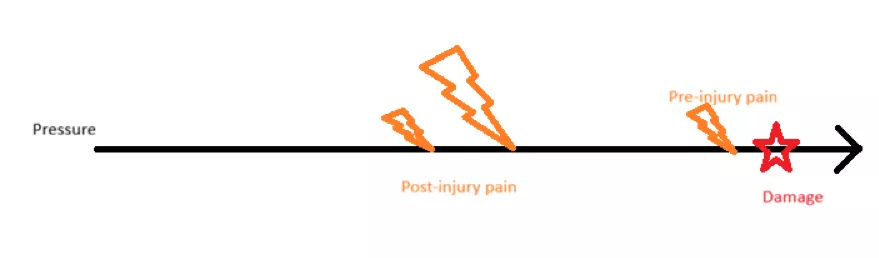
Let me give you an example of how I would use this diagram.
Before the onset of my shoulder pain, I could lift a 20kg dumbbell and I would get a mild discomfort in my shoulder, but I felt fine the next day (indicated by the orange lightning bolt closest to the red star). Unfortunately, I lifted a 25kg dumbbell and hurt my shoulder (injury indicated by the red star). I rested for six weeks and my shoulder felt better. However, when I got back to the gym, I felt a mild discomfort lifting a 5kg dumbbell (indicated by the first orange lightning bolt) and a sharp pain lifting a 10kg dumbbell (indicated by the large orange lightning bolt). The pain from lifting the 10kg dumbbell went away after two days. The initial injury took six weeks to settle, which suggests my shoulder was just “angry” from lifting the 10kg dumbbell, not re-injured. When I went to the gym a week later, I still felt a mild discomfort lifting the 5kg dumbbell, but my shoulder felt fine the next day.
In this example, my shoulder had healed from the injury, but had become sensitized.
How to build strength with a sensitized joint
We have known for decades that initial strength gains from resistance training come primarily from neural adaptations.[1] Neural adaptation essentially means that the muscles engage in a more effective way. So, you don’t need to lift heavy to start building strength.
Further, we now understand that the pain reduction benefits of exercise are not all attributed to strength development. [2,3] So, you also don’t need to lift heavy to start to see some of the pain-relieving benefits of exercise.
Additionally, as I discuss in the afore mentioned blog, Hypermobility: Taking Control of Unstable Joints, joint stability is not just about strength, it is also about training the muscles proprioceptive system. So, you can start improving joint control without building muscle.
I know, I know, you read this blog to learn how to build muscle and I imagine you are saying, “I get it, strength building with a sensitized joint starts light, but how do I get past the pain system to start to lift heavier?”
The answer, desensitization.
Desensitization
“No pain, no gain” isn’t true when it comes to exercising to help chronic pain.[4] But, could “a little pain, get the gain?” The theory of graded exposure or “edging” to physically desensitize has been around for a long time.[5] Essentially, “edging” is taking a painful activity to the onset of mild discomfort, or the “edge” of discomfort, and stopping the movement before the pain increases.

The aim is for your body to experience a particular movement without consequence many times so that the alarm system says, “oh, I don’t need to be that protective.” Another way to think about this process is that you have given your body credible evidence of safety. [6,7]
In my experience, there are a number of ways to apply desensitization principles to exercises. There is the “no pain” way, the “a little pain slow gain” way, and then there is my personal choice, the “a little pain to get the gain” way. Let me explain.
In the shoulder pain example above, I could lift a 4kg dumbbell until a 5kg dumbbell was no longer provocative of the shoulder and then lift a 5kg dumbbell until a 6kg dumbbell was not provocative and so on. Alternatively, I could lift a 5kg dumbbell until it no longer hurts and then start lifting a 6kg dumbbell until it no longer hurts and so on. Instead, I could lift a 5kg dumbbell for six weeks and if the pain is no worse, then start lifting a 6kg dumbbell for six weeks and if the pain is no worse, then lift a 7kg dumbbell as so on. In all these examples the aim is to show the body that it can perform the task without consequence.
You may well ask, why six weeks? Well, I haven’t seen a lot of strong research on how long it takes to desensitize and I suspect that is because the process is different for different people and different injuries. I write about some of my desensitizing experiences in my three-part blog post Recovering from Chronic Pain. However, there is one study from a group of researchers in Denmark that found that after six weeks of daily stretching they measured a significant reduction in sensitivity.[8] This six-week example has also rung true to my pain experiences when it comes to returning to strength training after an injury.
The Take-Away
Pain is a lot more complicated than just weak muscles and unstable joints. I recommend using a graded exposure approach in which you start very light and very gradually build strength. Respect the pain system and the strength will follow.
- Sale D. G. (1988). Neural adaptation to resistance training. Medicine and science in sports and exercise, 20(5 Suppl), S135–S145. https://doi.org/10.1249/00005768-198810001-00009
- Powell, J., Wood, L., Cashin, A. G., & Lewis, J. S. (2025). It is not all about strength: rethinking mechanistic assumptions in exercise-based rehabilitation for musculoskeletal pain relief. British journal of sports medicine, bjsports-2025-110372. Advance online publication. https://doi.org/10.1136/bjsports-2025-110372
- Sluka, K. A., Frey-Law, L., & Hoeger Bement, M. (2018). Exercise-induced pain and analgesia? Underlying mechanisms and clinical translation. Pain, 159 Suppl 1(Suppl 1), S91–S97. https://doi.org/10.1097/j.pain.0000000000001235
- Tran, I., Gibbs, M. T., Yu, N., Powell, J. K., Smith, B. E., & Jones, M. D. (2025). Effectiveness of Painful Versus Nonpainful Exercise on Pain Intensity, Disability, and Other Patient-Reported Outcomes in Adults With Chronic Musculoskeletal Pain: An Updated Systematic Review With Meta-Analysis. The Journal of orthopaedic and sports physical therapy, 55(8), 1–11. https://doi.org/10.2519/jospt.2025.13253
- Schemer, L., Glogan, E., Sjouwerman, R., Ahm, R., Ashar, Y. K., Boddez, Y., Boersma, K., Caneiro, J. P., Cima, R. F. F., Hollander, M. D., Flink, I., Glombiewski, J. A., Goossens, M., Harrison, L. E., Hedman-Lagerlöf, M., Huijnen, I. P. J., King, S., Köke, A., Linton, S. J., Ljótsson, B., … Vlaeyen, J. W. S. (2026). Exposure-based Interventions for Chronic Pain and Bodily Symptoms: A Special Interest Meeting Report. Behaviour research and therapy, 199, 104998. https://doi.org/10.1016/j.brat.2026.104998
- Kennedy, H., Harvie, D. S., & Coppieters, M. W. (2024). Do threats and reassurances reside in the biological, psychological or social domain? A qualitative study in adults and young people with chronic pain. British journal of pain, 18(6), 472–481. https://doi.org/10.1177/20494637241263291
- Moseley, G. L., & Butler, D. S. (2015). The explain pain handbook: Protectometer. Noigroup Publications.
- Støve, M. P., Thomsen, J. L., Magnusson, S. P., & Riis, A. (2024). The effect of six-week regular stretching exercises on regional and distant pain sensitivity: an experimental longitudinal study on healthy adults. BMC sports science, medicine & rehabilitation, 16(1), 202. https://doi.org/10.1186/s13102-024-00995-2